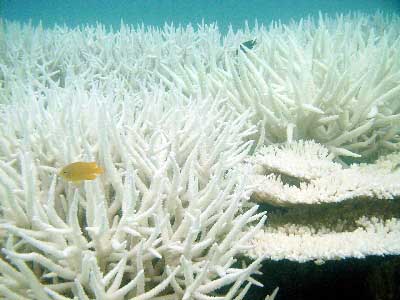
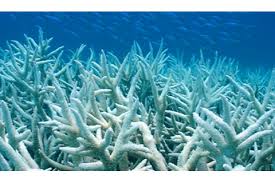
HAWAII – NOAA (the National Oceanic and Atmospheric Administration) declared the world’s third coral bleaching event is underway.
In a release last week, NOAA announced that warming ocean temperatures, seen already off the coast of Hawaii were the cause of widespread coral bleaching across Hawaii.
Scientists confirmed similar stressful conditions in the Caribbean.
Coral bleaching occurs when corals are stressed by changes in conditions such as temperature, light, and nutrients. The coral reacts by expelling the symbiotic algae living in its tissues, causing it to turn completely white.
The expansion prompted the declaration of the third global coral bleaching event ever on record.
Coral bleaching occurs when corals are stressed by changes in conditions such as temperature, light, and nutrients. The coral reacts by expelling the symbiotic algae living in its tissues, causing it to turn completely white. – National Ocean Service, Ocean Facts
According to NOAA, corals in Puerto Rico and the U.S. Virgin Islands are at risk. The Florida Keys and South Florida have already seen evidence of the bleaching, although it is expected to diminish.
“The coral bleaching and disease, brought on by climate change and coupled with events like the current El Niño, are the largest and most pervasive threats to coral reefs around the world,” said Mark Eakin, NOAA’s Coral Reef Watch coordinator. “As a result, we are losing huge areas of coral across the U.S., as well as internationally. What really has us concerned is this event has been going on for more than a year and our preliminary model projections indicate it’s likely to last well into 2016.”
The first coral bleaching episode happened in 1998 and the second in 2010. The latest event that began in the summer of 2014 was said to have hit the U.S. coral reefs disproportionately hard.
Climate.gov reported that conditions in the South Pacific and Indian Oceans in 2015 led to increased bleaching, with island nations in the South Pacific reporting impacts during the region’s peak bleaching season from January through March.
NOAA estimated that by the end of 2015, almost 95 percent of U.S. coral reefs will have been affected by changes that can cause coral bleaching.
The agency developed a Coral Reef Watch program to monitor current and potential bleaching events.
Photo courtesy NOAA Coral Reef Watch and Climate.gov.



 TraceyC Media